Business Rules
Business Rules lets users define a list of Rules that can be used to provide context for groups of Test cases.
The Business Rules view can be accessed on the Catalog page under the Business Rules tab.
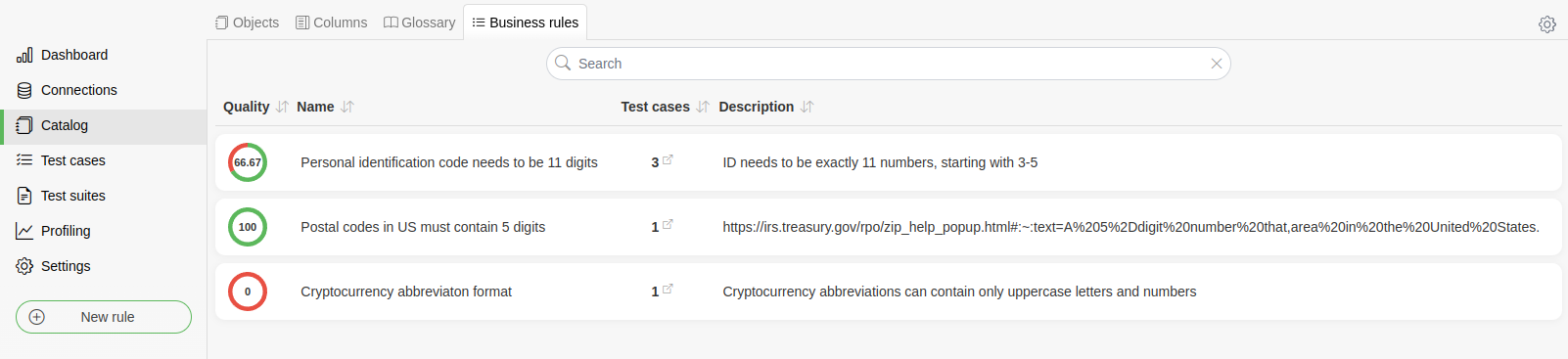
The list shows Quality, Name, Hierarchy, Test cases, Description, Owners and Roles, plus a column for every business rule custom field. The visible columns and their order can be customized from the table settings in the table header.
Create a Business Rule
The "New rule" dialog is opened from the toolbar above the list. Business Rules have a name, description, owners and roles.

Name - Business rule name
Description - Short description of business rule
Owners - Business rules owners. Can edit business rules
Roles - Role(s) of allowed edit users. Users with selected role(s) can edit business rules
Directory - Each business rule can be assigned into a custom directory to create a directory-based structure for business rule management
Assigning a test case to a Business Rule
A test case can be assigned to a Business Rule from the Test cases page.
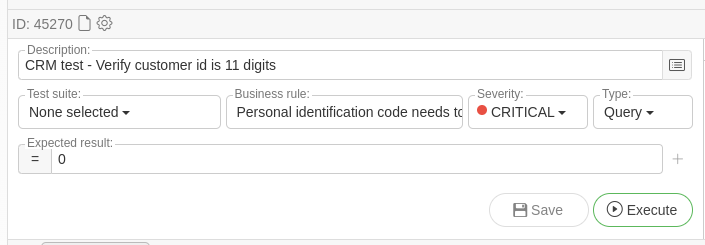
Searching for Business Rules
The search in the top of Business Rules finds Business Rules by the name or description.

Directory
Each business rule can be assigned into a custom directory to create a directory-based structure for business rule management.
The directory dropdown in the toolbar filters the list to the selected directory ("All rules" shows everything); the folder button next to it opens the Rule directories modal, where directories and sub-directories can be created, edited and deleted.
View Business Rule's detailed info
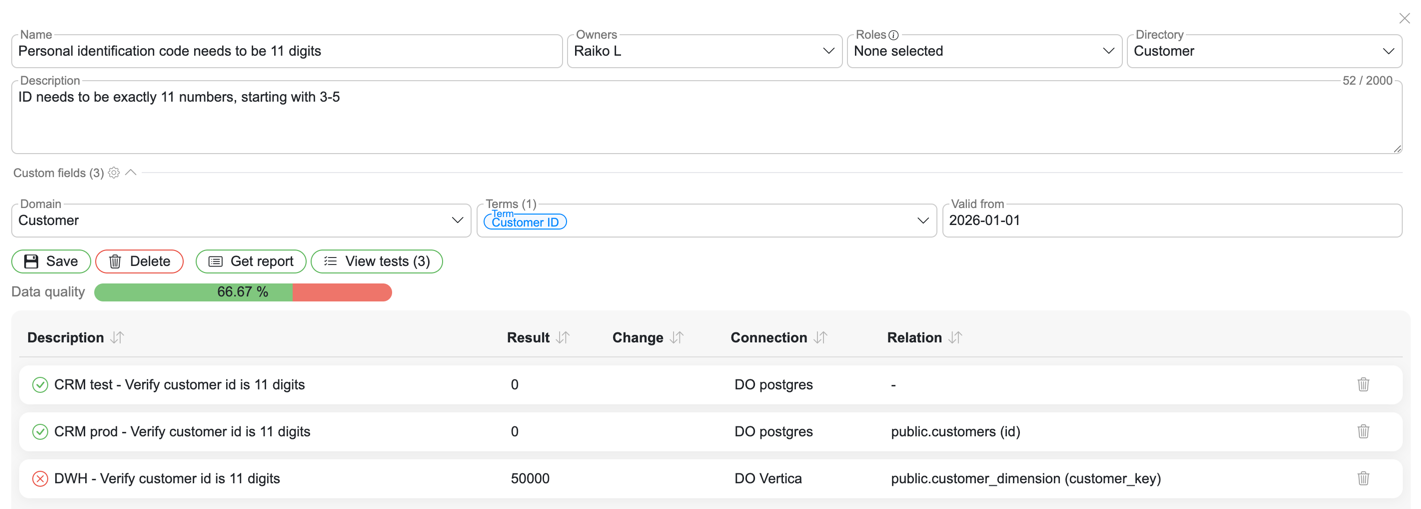
Clicking on a row in the Business Rules list will open its detailed view. The sidebar holds the editable properties:
Name
Description
Owners
Roles
Directory
Custom fields - list of custom fields enabled for the entity type
Business rule
Below those sits a Test generation section:
Dynamic rule - the SQL-template dynamic rule used to generate this rule's test cases. The pencil edits it, the plus creates a new one
Linked terms - the glossary terms this rule applies to, with their count in the label
Auto-generate - while on, assigning one of the linked terms to a column creates that column's test case automatically
Whether a rule is column-based or object-based changes what can be generated, and the section says which one applies. A column-based rule (its SQL uses <column>) can produce one test per attribute of the linked terms. An object-based rule creates tests one at a time instead.
The main area shows the rule's quality score and the Test cases and Reports tabs.
Generate a report
Reports are generated from the Reports tab of the detailed view. Generate report offers Excel report or HTML report, covering the test cases connected to the given Business Rule, and each one is kept in the tab's history with its Created at and Type. Generating is only offered once the rule has test cases, and a stored report is deleted from the same list, behind a confirmation.
Generating test cases
Test cases are created directly from the rule with the New test button. On a column-based rule it opens a menu with two options:
Using dynamic rule - creates test cases from the linked dynamic rule against a chosen Connection and Test suite, with a Preview of the resulting SQL. A dynamic rule has to be linked and saved first
Using term attributes - lists the attributes linked to the rule's terms that have no test case yet, by connection, schema.object and attribute. Pick the ones you want and press Create selected
Either way the generated tests are linked to the business rule.
Business Rule's test cases table
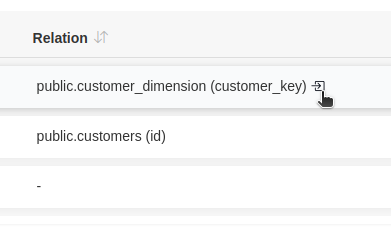
The Test cases tab lists the associated test cases with their Description, Result, Connection and Relation. When some of them are outside the user's access, the tab warns that not every test case is visible.
Navigating to a single associated test case
The whole row is clickable: clicking anywhere on it opens that test case's detailed view.
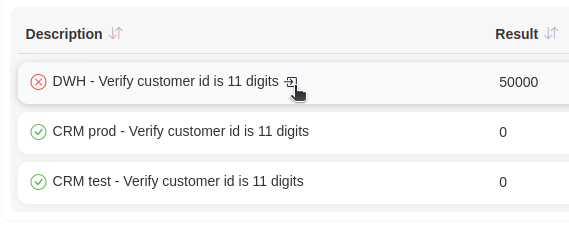
Navigating to the catalog object related to a test case
You can jump to the specific object in the catalog by clicking on the icon that appears next to the test case's relation while hovering over the test case. When the test case targets specific columns, they are listed after the object name.
Deleting a test case association
You can delete an association between a Business Rule and a test case by clicking on the icon in the end of a row in the test cases table. A confirmation asks before the relation is removed; the test case itself is not deleted.